
In an era defined by rapid technological innovation, artificial intelligence has become both ubiquitous and unsettled. Part commodity, part question mark, it’s woven its way into nearly every industry and the general culture. Released to the public in 2022, ChatGPT alone handles 2.6 billion messages per day.
Among those queries lies a creative conundrum: Can AI create art that carries the depth and originality of human work? And if mainstream audiences decide that it can, what does that mean for artists?
Writing Through Disruption
Lori Goldstein ’95 has long been a student of the craft. After graduating from Lehigh with a degree in journalism, she entered the industry chasing the same adrenaline she’d felt in The Brown and White newsroom. Nothing quite replicated that spark. She changed roles several times, but nothing felt right.
At her husband’s encouragement, she stepped away to reassess. In that pause, she rediscovered her ambition to write novels.
“It didn’t start off well,” she laughs. “I could write, but learning to write a well-told novel is different. There’s a set of skills you need, and I didn’t know them yet.”
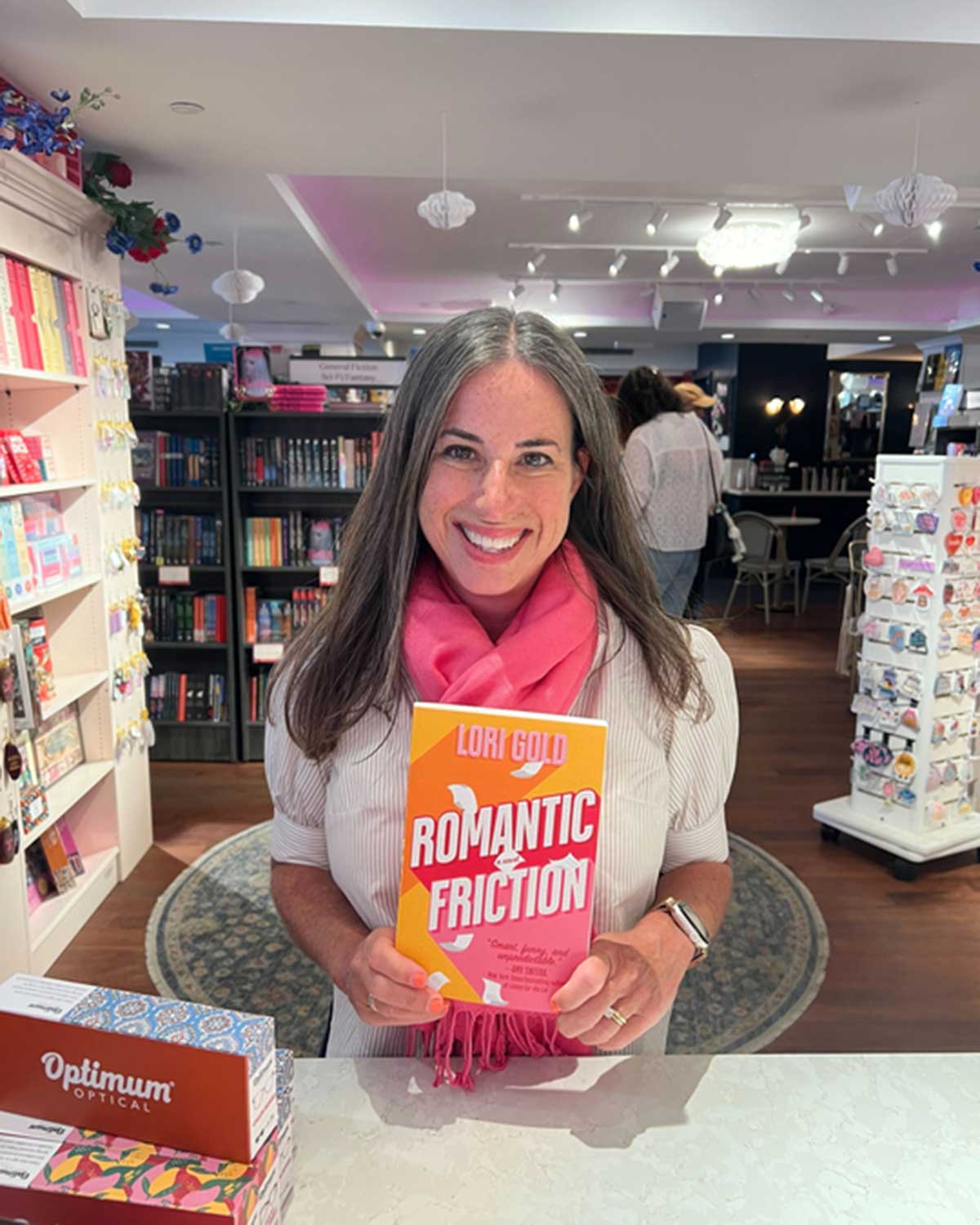
Goldstein treated her first novel as a self-designed Master of Fine Arts. For three years, she immersed herself in studying technique, experimenting, failing, and revising. Her next novel took only three months.
The idea for Romantic Friction came to her during the summer ChatGPT entered the public sphere. At first, she used the tool playfully, asking it to compose poems in the style of characters from Game of Thrones.
But the novelty gave way to something more unsettling.
While teaching a creative writing class at Boston’s Grub Street writing center, Goldstein listened as one of her students voiced a frustration: “What are we even doing this for? AI is going to write all the books for us, and this career will be gone.”
The comment lingered.
“That was the first time I realized AI was consequential,” she says. “At the time, ChatGPT was new and not very good. But what if it became good enough? I spun that idea in my head.”
The Machine in the Middle
Romantic Friction grew from that tension and from Goldstein’s experience navigating the publishing industry. The novel follows Sofie Wilde, a bestselling author whose career is threatened when a debut author openly uses AI to produce books in Wilde’s style. The satire reflects a very real anxiety shared by many working writers.
Consider Coral Hart, a romance author who published more than 200 AI-written novels under various pen names on Amazon in 2025. None became runaway hits, but the volume earned her a six-figure income. She now teaches others to do the same.
“The issue with AI in the arts is that we believe art comes from a very human place,” Goldstein says. “If someone else wrote The Hunger Games, even with the same plot points, it would be an entirely different book. That’s what makes art great. With AI, everything risks becoming an amalgamation. Stories would become diluted and repetitive. In my cynical moments, I worry it will influence how we create. But I also believe people will still crave that human element.”
Haiyan Jia, associate professor in the Department of Journalism and Communication, studies how technology shapes the way people interact with information, with each other, and increasingly, with AI.
Two years ago, Jia led a series of experimental studies exploring perceptions of AI authorship. Participants read the same news articles, labeled with different authorship descriptions: human only, human with AI tools, human with AI assistance, human with AI collaboration, and AI as the sole author. Even when participants were clearly told an article was written exclusively by a human, many assumed AI had been involved. Conversely, when informed that AI had been the sole author, participants still believed that humans must have played a role — initiating the creative process, verifying the information, or approving the publication.
“In people’s minds, AI is becoming an integral part of how content is created,” Jia explains. “They come up with their own assumptions and theories of how it’s used, even if presented evidence to the contrary.”
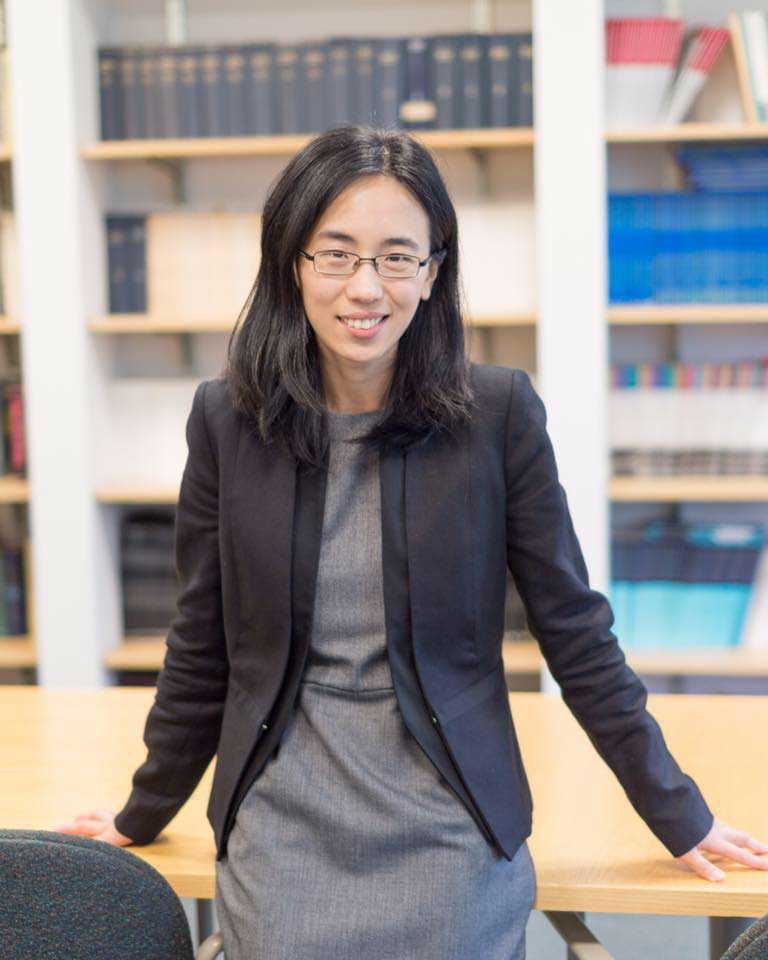
Jia cautions against over reliance on AI tools for writing and creative work. She points to the growing literacy crisis, ethical concerns such as copyright infringement, the devaluation of human labor, the authenticity of creative content, and the tendency to normalize technological shifts without examining their long-term impact.
The Future of the 'Bestseller'
Earlier this year, two of the nation’s five largest publishing companies posted job descriptions for AI engineers. While the roles didn’t involve using AI to write books, they signaled an interest in predictive modeling using algorithms to forecast which manuscripts would succeed commercially.
AI models, Jia warns, contain biases. They generate what is statistically most likely, which often reflects historic inequalities.
“We know the stories that have been told have been dominated by certain groups,” she says. “There’s historic baggage in that data. We’re seeing diverse authors challenge that, but if AI is used to determine what gets published, we risk regressing to what stories used to look like. Popular voices may stay amplified, but emerging voices may be smothered.”
Still, both Jia and Goldstein maintain that human creation carries an essence AI cannot replicate.
“When we talk about authorship,” Jia says, “we have to actively want human connection. We have to prioritize empathy. We want to see and be seen. That requires accepting imperfection in art. It may begin with something simple, like choosing to read a book written by a human, flaws and all, and embracing it.”
With predictive models and AI embedded in daily life, the future of creative work may ultimately rest with audiences.
“Whether authors or artists choose to use AI will be determined by the marketplace,” Goldstein says. “Don’t be passive. Vote with your dollar. Support the creators you believe in. Over time, those choices add up.”
“You do have power,” she adds. “Use it.”