
Mansour G. Mansour opens the doorway to the cellar in an old factory building in Allentown. Like many spacious basements, it holds organized piles of items. Amid boxes and collections, hulking green machines lie dormant — some now serve as convenient surfaces for storing tools and supplies.

Mansour clears a few things from the work surface of one machine and reaches for a switch on the back wall. The engine sputters to life, and a rubber belt begins to whirl. He picks up a scrap of leather, places a metal die on top, and slides it into the press.
Ka-chung.
Punched out is the first piece of what would become a black size 6 women’s sandal.
When Mansour first came to the United States in 1976, he wanted to buy new sandals, but nothing suited him. The fit, style, comfort, and toe exposure were never in the right balance.
As the son of an old-world cobbler, he set out to make his own pair. After a weekend of design, labor, and construction, he created something he liked.
The first time Mansour wore the sandals out of the house, they caught the attention of a bank teller. When he told her that he had made it himself, she asked for a pair of her own — red, with white stitching.
That was the moment he realized he might have a product others would want to buy.
Thus his venture began. The route has been circuitous as he found support at Lehigh through its then-nascent Integrated Product Development program, bought a factory, purchased equipment, won awards, and earned coverage in The New York Times. But hard times followed, and the business stalled.
Now, 30 years later, Mansour is back in the shoe business, and he fondly remembers the role Lehigh played in his entrepreneurial journey. His sandal, in turn, holds a meaningful place in Lehigh’s entrepreneurial history, kick-starting the programming that helps define Lehigh today.
Here’s how the Everywear Footwear sandal opened new pathways to deliver experiential and interdisciplinary learning.
Finding Lehigh
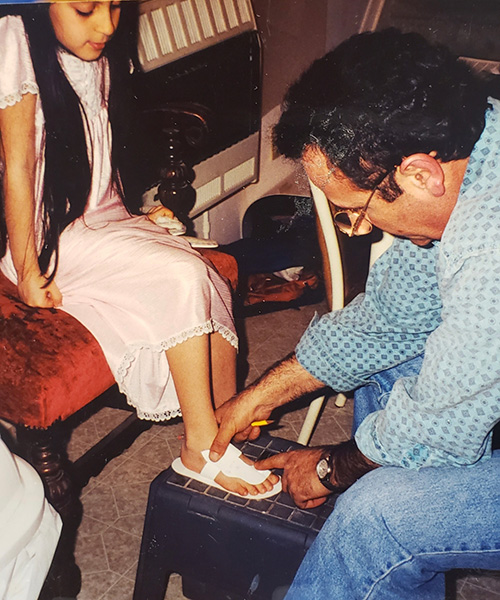
Mansour began by making sandals for folks who took notice. One day in July, he wore them to Champs in Easton — the bar owned and operated by former heavyweight boxing champion Larry Holmes.
Soon he was making a pair for Holmes, who promised feedback as quick as his jab. The boxer slipped them on and praised the combination of style and comfort.
A friend’s referral brought Mansour to Ben Franklin Technology Partners, where leaders saw promise in the sandal and thought it could be a new project at Lehigh.
It was 1992, and Todd Watkins, professor of economics and today’s executive director of the Martindale Center for the Study of Private Enterprise, had just joined the Lehigh faculty. He was building a close working relationship with John Ochs, professor of mechanical engineering and leader of the department’s capstone course.
The capstone had students working on real projects with industrial clients. Watkins saw the work as revolutionary, pushing the boundaries of experiential learning. Ochs, meanwhile sought Watkins’ interdisciplinary perspective — a blend of optical engineering, public policy, and finance. Both had a strong interest in innovation and entrepreneurship.
Soon, business students were added to the engineering capstone course. That interdisciplinary approach would later lead to a new program co-founded by Ochs and Watkins: Lehigh’s nationally award-winning Integrated Product Development (IPD).
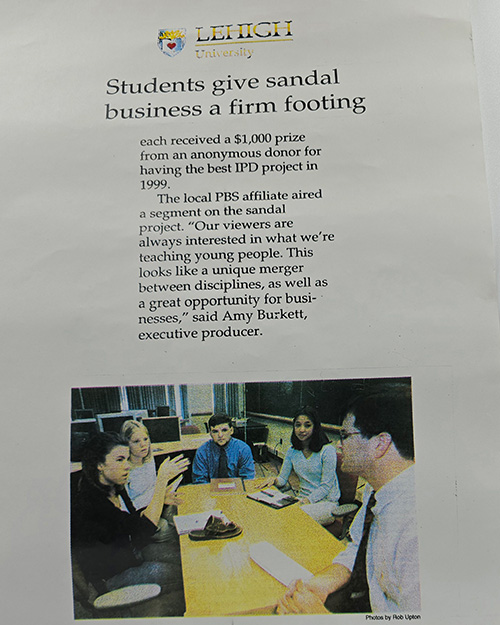
One of the program’s first projects was Mansour’s sandals.
His footwear was later featured in numerous federal grants and highlighted in the New York Times as an example of innovative approaches to applying academic knowledge.
Success was afoot, not only for Mansour’s project, but for others that followed.
Fast forward a few years to when IPD’s recognition and outcomes helped launch a new major: integrated business and engineering. It also led to new, innovative programs that continue to shape Lehigh today.
Watkins became the founding executive director of Lehigh's Baker Institute for Entrepreneurship, Creativity, and Innovation, and Ochs went on to found and direct Lehigh's Technical Entrepreneurship program and oversee the professional master's program in technical entrepreneurship.
Sandals and Students
Students worked with Mansour across three phases. In phase one, engineers helped create dies for each component of the sandal and constructed it for optimal aesthetics, adaptability, and comfort. Mansour remembers them painstakingly making small adjustments to ensure the buckle lay smoothly across the foot.
Phase two brought in marketing research students who tested the sandal, comparing it to popular competitors of the time, including Clarks, Birkenstock, and Teva. The team went to the King of Prussia mall, where participants tried on multiple sandals and shared their impressions.
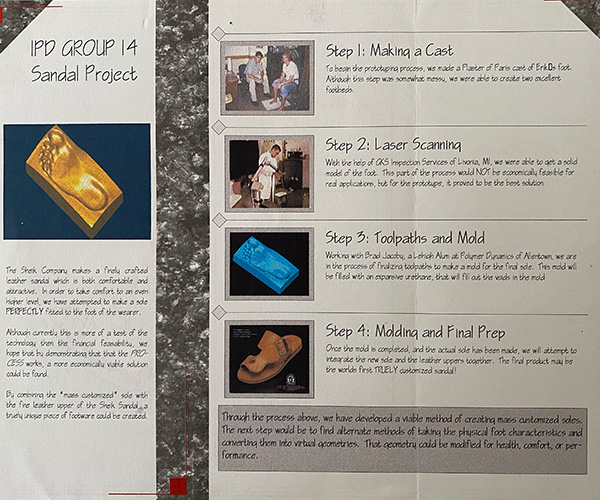
In phase three, students tested whether the sandals could be made to order using computer aided design software to scan a person’s foot and mold a sole for a precise fit.
The team also counseled Mansour on business decisions, including advising against the purchase of shoe-manufacturing equipment that Watkins thought belonged in a museum. Mansour ultimately made his own call, purchasing the equipment and then a factory building in Allentown.
Mansour worked to train equipment operators, fix broken machines, and, eventually, run each one himself. But as bills mounted and production lagged, Mansour realized he needed to pivot. He retained the patent on his sandals and kept the dream alive.
Deferred no longer, the sandals are now back in production. While the machines that once cut, buffed, pressed, trimmed, and glued sit idle, Mansour has outsourced production this time around. He is using the original dies made at Lehigh and applying marketing insight, still confident no other sandal offers what his does.
He remains deeply grateful for Lehigh’s belief in both his story and his product. Everywear Footwear is finally on the market, and the sandals he first imagined decades ago are available to purchase.
Mansour hopes they will soon grace the feet of some at Lehigh who helped made it all possible.