
It’s a cold Christmas morning in Allentown, Pennsylvania. Ron Amey ’74 is working alongside his mother as she puts the finishing touches on a roasted turkey with all the trimmings.
Amey is about to place a teaspoon of sulfur over an alcohol burner lamp included in the Gilbert chemistry set he opened that morning.
The yellow powder transforms into a deep orange liquid. As the liquid ignites, it burns with a beautiful blue flame. The 12-year-old Amey is transfixed.
A colorless, suffocating gas overpowers the delicious holiday aromas, and for half an hour the family stands outside in the frigid air with the kitchen windows flung open.
While his parents begrudgingly accept that their gift has disrupted part of the day, Amey is completely hooked and soon reigns supreme over a chemistry lab in the basement.
That lab, supplied with chemicals from a nearby hobby shop and the local Rexall drugstore, would soon churn out experiments and homemade fireworks. Beyond blowing things up in the backyard, Amey set his sights on higher goals.
His ambitions were fueled by his high school advanced placement (AP) chemistry teacher, a chemist with a doctorate who retired from Merck.
After Amey participated in several high school science fairs, his curiosity led him to his senior year project: an analysis of the adhesive that barnacles secrete.
Amey and his parents hauled 10-gallon jugs of ocean water and buckets full of barnacle-covered rocks and driftwood from the beaches of New Jersey. He set out to analyze the adhesive properties of the tiny crustaceans.
His work was also helped by a friend’s father, who granted him supervised access to a lab and equipment at an area college.
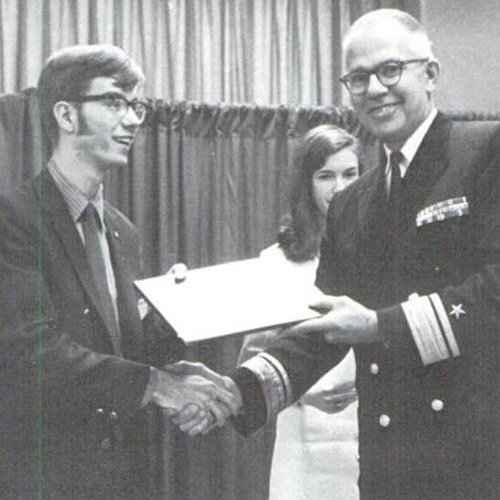
During Amey’s senior year of high school, his work on barnacles earned him top marks in the Lehigh Valley Science Fair. He was then invited to the Westinghouse Science Talent Search in Washington, D.C., where his work was judged by a recipient of the Nobel Prize in chemistry and the inventor of electronic flash photography.
His success at this stage generated an invitation from the president of Mack Trucks to fly to Cape Canaveral, where Amey and others sat in the VIP section to watch the launch of Apollo 13. Amey borrowed a 35mm camera from his high school Spanish teacher to capture images of liftoff.
At the International Science & Engineering Fair in Baltimore, Maryland, Amey earned the Navy Science Cruiser Award. Besides snagging a Doors concert ticket while in town, he was rewarded with an invitation to the Japan Science Student Fair in Tokyo, Japan, a two-week extravaganza that included a tour of Kyoto.
The Navy award also earned him a two-week oceanography course held in St. Croix, U.S. Virgin Islands. Amey’s barnacle research was then published in 1970 in an American Chemical Society journal.
Life at Lehigh
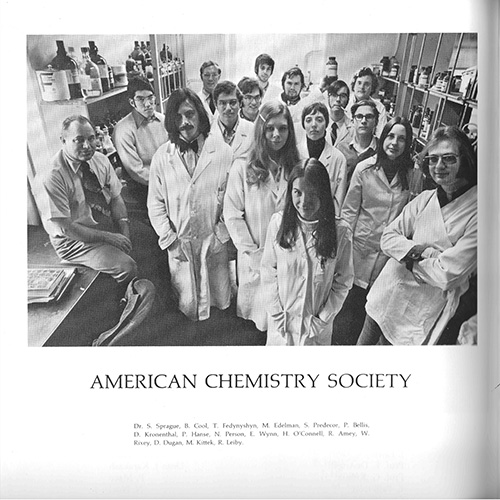
To fan the flames of his chemistry ambition, Amey looked for a university. He wanted an institution with an outstanding chemistry program that was close to home and would accept his National Merit Scholarship. His AP teacher told him to look at Lehigh.
He came to South Mountain as a commuter student. Ned Heindel, Howard S. Bunn Emeritus Professor of Chemistry, led a strong group of graduate and postdoctoral fellows who befriended Amey and supported his undergraduate research.
He partnered with the smartest lab student in the building, Emily Winn-Deen ’74. It didn’t take long for him to realize he’d need a doctorate to conduct the kind of research that interested him.
Amey’s second publication came from his summer research conducted under Heindel’s direction. Beyond classroom and lab experiences, Amey took on many projects for the department.
He cleaned out the attic in Chandler Hall, where faculty members had stored plants and minerals brought back from early global expeditions. One specimen, an ostrich egg, had broken. Heindel told him to toss it, but Amey glued it back together. It still sits on his bookshelf.
Another project had him index and catalog the chemicals in the hallway cabinets — and safely store flammable compounds.
He once joined Heindel for lunch with noted scientist and writer Isaac Asimov.
Amey was a member and president of the American Chemistry Society, sat on Town Council, and was inducted into Phi Beta Kappa, Tau Beta Pi, and Phi Lambda Upsilon. He earned the William H. Chandler Chemistry Prize in 1974 and graduated with highest honors and departmental honors.
On to Graduate School
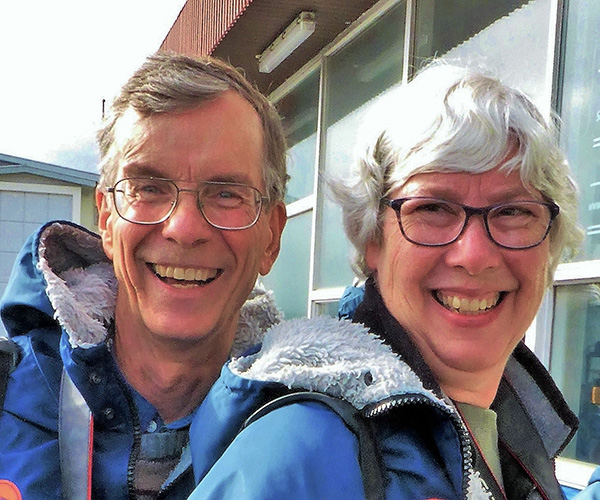
Amey found a prestigious team and likeable colleagues in chemistry at the University of Illinois Urbana-Champaign and got to work on his doctorate.
He also found his lifelong love, Gail Swenson, a senior earning her bachelors in mathematics. She often sat at the graduate student table in the dining hall.
One day, while running late for lunch, Amey bumped into her as she discussed a tour of France where she studied the language and cooking. His Gourmet magazine subscription came up, and soon the two were talking more and going on dates to the concert hall.
Despite the distractions of campus social life, Amey continued to focus on his thesis research. His advisor had a reputation for keeping graduate students for six or seven years. But in his fourth year, his advisor told Amey to wrap things up and start interviewing for jobs.
Career at DuPont
The Ameys both landed at DuPont — she in information technology and he in central research and development. His career ranged from blue sky research to patent liaison work, from nylon intermediates research to specialty chemical manufacturing.
The bulk of his career was in new business development, turning waste products, by-products, and co-products into useful, marketable products. The team joked how they worked from A to Z, developing additives for asphalt and zeolite catalysts for fuel.
Amey developed materials for paints, coatings, epoxy, fragrances, and, ironically enough, products designed to prevent barnacles from adhering to marine coatings.
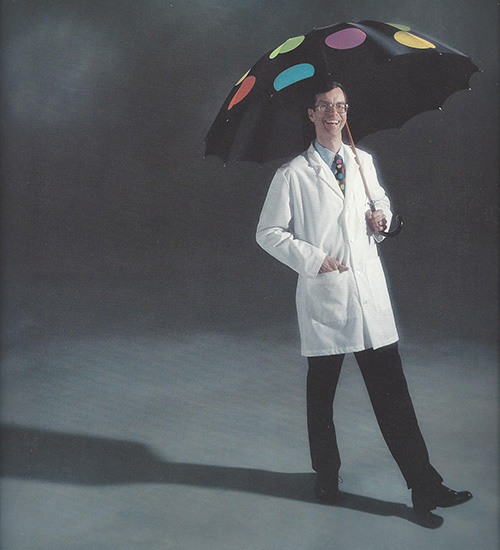
During his DuPont career, he received two Corporate Marketing Excellence awards, one individually and the other as part of a team. He also starred in a chemistry advertising campaign.
When DuPont sold off the nylon intermediates business, he spent the final decade of his career at Koch Industries INVISTA doing similar work.
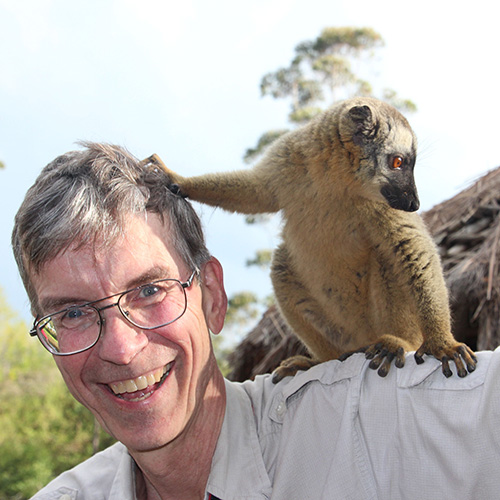
While his work often took him around the world, the Ameys love an adventure. Together, they have visited 53 countries, toured Africa 12 times, journeyed through Asian steppes, and explored sites including the Egyptian pyramids, Machu Picchu, and Angkor Wat.
The Ameys always bring their cameras to capture images of wildlife, architecture, landscape, and culture.
They are passionate supporters of the Philadelphia Zoo and its conservation work — the organization took them on their first safari.
Amey also is active at Lehigh, serving on the Dean’s Advisory Council for the College of Arts and Sciences. The Ameys have created an endowment supporting summer undergraduate chemistry research — something of lasting impact.
“Lectures and labs are necessary and helpful, but research is the only way to discover what students really want to pursue,” he says.
The Ameys use their IRA to make a qualified charitable distribution supporting that endowment. They also set up a donor-advised fund that they continue to grow.
“I received merit and financial aid scholarships as a student,” he says. “We want to support students so they don’t have to struggle to get what they need. No one can do it alone. There is so much talent in need of resources. We want to be there to help them ignite their passions and forge a pathway forward.”
Same fire he had, but less sulfur this time.